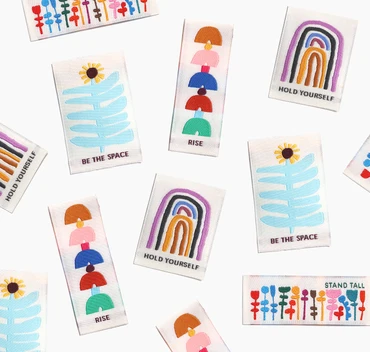
Buying custom woven labels looks simple until the first sample arrives: colours shifted, edges scratching the neckline, the logo unreadable at 20 mm. Nearly every failure traces back to a decision that was never made explicitly. This is the sourcing path we recommend for first-time and repeat apparel buyers alike.
1. Fix the specification before you request a quote
A quote without a specification is a guess, and guesses inflate cost later. Lock these five items first:
- Size and fold type — e.g. 20 × 30 mm center fold, or 25 × 40 mm straight cut. Fold type changes sewing time on your line, so involve the production team, not just design.
- Weave class — damask for detailed multi-tone logos, satin for glossy bold marks, taffeta for economy flat-colour labels. See custom woven labels for weave and density options.
- Colour count — each additional weft colour is a set-up step, not just an ink slot.
- Edge treatment — ultrasonic soft cut for skin-contact neck labels, hot-knife selvedge for hem and side-seam labels.
- Annual volume and reorder cadence — unit price falls sharply from 100 to 500 to 1,000 pcs, so quote against 12-month demand instead of the pilot style.
2. Prepare artwork that weaves can actually hold
Woven labels are built from threads, so detail has a physical floor. Supply vector AI, PDF or EPS with text outlined, at 1:1 mm scale, colours on separate spot layers. Keep letter height at 2 mm minimum and line weight at 0.4 mm minimum; anything finer becomes a blur of floating threads. Drop shadows, gradients and photographs cannot be woven — simplify the mark to flat separations before sending it.
3. Confirm colour against a textile standard, not a screen
Ask for Pantone TPX (textile) or PMS C references and request the yarn colour card with your purchase order. Screens are the worst colour reference in the industry, and a brand black woven as a warm charcoal will read as off-brand on every garment.
4. Proof, then sample, then bulk — never skip a step
A digital proof validates layout and size; a woven physical sample validates hand feel, edge softness, colour and how the label behaves after stitching and washing. Standard timing is proof within 24 hours, sample in 3–5 working days, bulk in 5–8 working days after approval.
When the sample arrives, check four things: legibility at arm’s length, edge sharpness against bare skin, colour match under both daylight and warehouse lighting, and dimension after a wash cycle.
5. Specify the wash and sew tests in the PO
Write the performance requirement into the order rather than hoping: industrial wash at 60 °C for 50 cycles without colour migration, no shrinkage or edge curl after stitching, and fold lines pre-marked if your sewing line uses an automatic folder. Buyers who skip this clause lose the only objective basis for a claim.
6. Inspect the bulk with sampling, not vibes
For orders above 5,000 pcs, pull AQL 2.5 random samples per carton and check colour consistency between lots, thread bridges in small text, and cut depth on fold edges. Batch-to-batch colour shift on genuine yarn dyeing runs 5–10 %, so reserve 10 % overage for critical colour programs.
7. Plan freight around your production calendar
Air freight is 3–5 days and suits launch drops; sea freight at 12–18 days suits reorder cycles. Label shortages stop a sewing line entirely, so the practical rule is to keep two months of consumption on hand and re-order at the 50 % mark.
Buyer’s checklist
- Size, fold, weave class, colour count and edge treatment specified in writing
- Vector artwork with 2 mm minimum text and 0.4 mm minimum line weight
- Pantone reference on the PO plus yarn colour card
- Digital proof and physical sample approved before bulk
- Wash and sew performance clauses on the PO
- AQL inspection plan above 5,000 pcs
- Freight chosen against the sewing schedule, with reorder point defined